
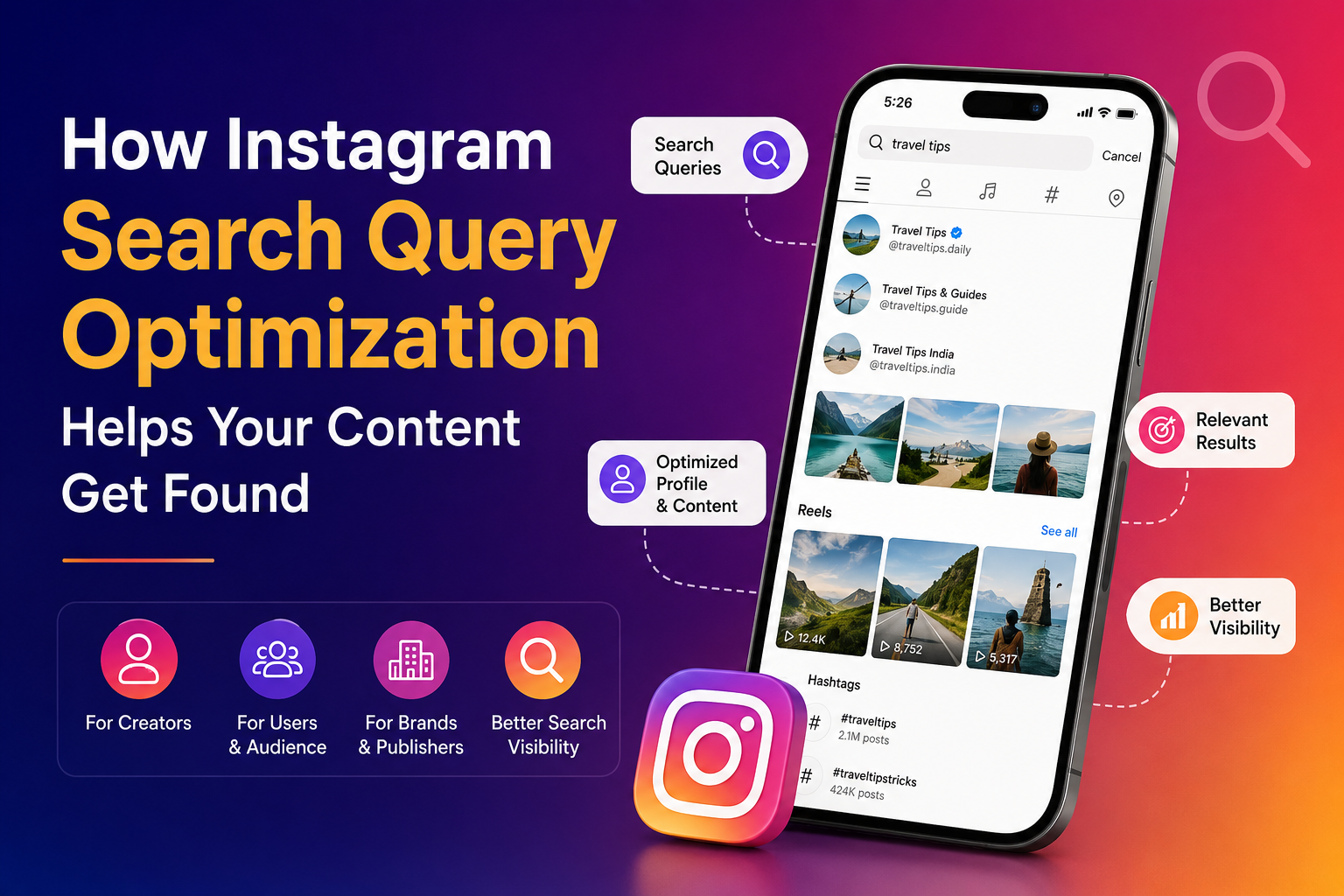
Instagram is no longer only a platform for following friends and watching Reels. People now use Instagram to search for creators, products, tutorials, businesses, places, ideas and information.
That makes Instagram search query optimization important for anyone who wants their content to reach people who are actively looking for a particular topic.
But optimizing for Instagram Search is not simply about adding keywords or hashtags. Instagram has to understand what a user is searching for, identify relevant accounts and content, and then determine which results are most useful for that particular person.
For creators, brands, publishers and ordinary users, the process looks different.
What Is Instagram Search Query Optimization?
Instagram search query optimization is the process of making your profile and content easier for Instagram to understand and match with relevant searches.
For example, someone might search for:
- Best smartphone photography tips
- Mumbai food places
- Easy dinner recipes
- Android battery-saving tips
- Travel creators in India
- How to edit Instagram Reels
Instagram needs to determine which accounts, posts, Reels, hashtags and places are relevant to each query.
This means your optimization starts with a simple question:
Does Instagram clearly understand what your content is about?
If the answer is yes, your content has a better opportunity to appear when people search for related topics.
How Instagram Understands a Search Query
From Instagram’s perspective, Search is fundamentally about connecting a person’s query with relevant results.
Instagram has explained that the text a person enters into Search is one of the most important signals. It can match that search against information such as usernames, profile names, bios, captions, hashtags and places.
Instagram also considers information about the person performing the search and the popularity of potential results.
That means there isn’t necessarily one fixed Search ranking for everyone.
Two people can search for the same phrase and see different results.
Search query
The words someone enters are the starting point.
If a person searches for “Android camera tips,” Instagram needs to find content that appears relevant to Android cameras and photography.
User activity
Instagram can also use a person’s activity to personalize results.
Accounts they follow, content they interact with and other activity can influence what they see.
Popularity
Engagement and popularity can also help Instagram determine which relevant results deserve greater visibility.
This creates an important distinction:
Relevance helps Instagram understand your content. Audience response can help demonstrate its value.
What This Means for Creators
For creators, Instagram Search is another way to reach people who don’t already follow them.
A creator shouldn’t think only about:
“How do I get my followers to see this?”
They should also think:
“What would someone search for if they needed the information in this post?”
Suppose you create smartphone photography content.
Instead of making every caption vague, you could naturally describe the subject:
5 smartphone photography tips for better low-light photos
Now the topic is much clearer to both the audience and Instagram.
The goal isn’t to repeat “smartphone photography” ten times.
The goal is to make the subject of the content obvious.
Your Instagram Name and Bio Matter
Your profile is one of the first places Instagram can get information about what you do.
Compare these two examples.
Example 1
Rahul
Creator | Life is an adventure
Example 2
Rahul | Mumbai Travel Creator
Mumbai travel guides, budget trips and weekend destinations
The second profile provides much more contextual information.
If travel is your niche, your name, profile description and bio should naturally communicate that.
This doesn’t mean stuffing keywords into your profile.
Instead, describe yourself in the same language your potential audience would use when looking for someone like you.
Also read: Best Creator SaaS Platforms to Grow Your YouTube, Instagram & TikTok
Write Captions That Explain the Content
Your caption should help people understand what they’re seeing.
A caption such as:
“This changed everything 🔥”
provides very little context.
A caption such as:
“Here are five Android battery-saving settings that can help reduce unnecessary background battery usage.”
immediately explains the topic.
That is useful for the reader and gives Instagram additional textual context.
The important word here is natural.
Don’t turn captions into collections of keywords.
Write for people first.
Think About Search Queries Instead of Just Keywords
One of the biggest mistakes in Instagram Search optimization is focusing only on individual keywords.
For example:
Keyword:
Instagram SEO
But a real user may search:
- How to get found on Instagram
- How does Instagram Search work
- How to optimize Instagram profile
- Instagram SEO tips for creators
- How to appear in Instagram Search
These are different queries, even though they revolve around the same subject.
This is where search intent becomes important.
Someone searching “Instagram SEO” may want a general explanation.
Someone searching “how to appear in Instagram Search” wants actionable advice.
Someone searching “Instagram SEO tips for creators” has a specific audience and purpose in mind.
Good content addresses the reason behind the search, not just the words in it.
How Users See Instagram Search
From a user’s perspective, Search optimization should never feel like optimization.
Imagine searching:
best cafes in Mumbai
You want useful cafes.
You don’t want an account that simply repeats “best cafes in Mumbai” throughout its profile and captions.
Instagram therefore has to balance keyword relevance with other signals.
The best result is ultimately the one that helps the person accomplish what they came to Instagram to do.
This is why creators should avoid thinking of Search as a loophole to exploit.
Instead, think of it as a matching system:
User question → relevant content → useful experience
Your Existing Audience Also Matters
Your existing audience can indirectly contribute to your discoverability.
If people consistently watch, save, share and interact with your content about a particular subject, Instagram receives more information about the relationship between your account and that topic.
For example, suppose you regularly publish:
- Android tutorials
- Smartphone reviews
- App recommendations
- Phone troubleshooting guides
Over time, your account develops a clear topical identity.
This is more valuable than publishing completely unrelated subjects simply because they contain popular keywords.
Build topical consistency
If you want to be known for a particular subject, repeatedly create genuinely useful content around that subject.
Your profile should tell one coherent story.
How Publishers Can Use Instagram Search
Publishers have another opportunity.
A technology publisher, for example, may already produce articles targeting Google Search queries.
Instagram can extend that strategy into visual and social content.
Suppose a publisher’s website covers:
How to transfer WhatsApp chats to a new phone
Instead of posting a generic promotional Reel, the publisher could create an Instagram post specifically addressing that question.
The content could clearly communicate:
How to transfer WhatsApp chats to a new phone
The same principle works for:
- Technology publishers
- News organizations
- Entertainment websites
- Recipe publishers
- Travel publications
- Educational websites
- Review websites
The important difference is that Instagram content should be designed for Instagram rather than simply copying a website headline.
How Brands Can Optimize for Instagram Search
Brands can apply the same principles.
Consider a skincare brand.
A profile that simply says:
Official Account
doesn’t communicate much.
A profile that clearly identifies the company and its category gives users more context.
Individual posts can also address the questions customers actually search for:
- Best skincare routine for beginners
- How to use sunscreen
- Skincare routine for oily skin
- How to apply face serum
The same principle applies to restaurants, fashion companies, technology brands and local businesses.
Describe what you offer in the language customers actually use.
What About Hashtags?
Hashtags can provide additional context, but they shouldn’t become your entire Search strategy.
Using hundreds of unrelated hashtags won’t automatically make content relevant.
A better approach is to use hashtags that genuinely describe the subject of the post.
For example, a smartphone photography post might use hashtags related to:
- Smartphone photography
- Mobile photography
- Photography tips
- Phone camera
The exact selection should depend on the content.
Your caption, profile information and actual content should already make the topic clear.
Create Content Around Questions People Search
A particularly effective approach is to turn real questions into content.
For example:
Question:
How do I make my iPhone photos look better?
Content:
5 iPhone photography settings beginners should try
Or:
Question:
How can I save Instagram videos?
Content:
What Instagram lets you save and how the feature works
This approach naturally aligns your content with search intent.
Instead of asking:
“Which keyword should I put in this post?”
ask:
“What question is my audience trying to answer?”
That shift can significantly improve the quality of your content strategy.
Instagram Search Optimization Is Not Just About Keywords
The biggest misconception about Instagram search query optimization is that it is simply keyword placement.
It isn’t.
A stronger strategy combines several elements:
| Element | What it does |
|---|---|
| Profile name | Helps communicate who you are |
| Bio | Explains your niche or business |
| Captions | Provides context about individual posts |
| Hashtags | Adds topical context |
| Content | Demonstrates what the post is actually about |
| Audience activity | Provides behavioral signals |
| Relevance | Connects your content to the query |
| Popularity | Helps Instagram evaluate competing results |
No single element guarantees Search visibility.
Instagram has to evaluate the overall context.
A Simple Instagram Search Optimization Strategy
If you’re a creator or publisher, start with these steps.
1. Define your main topic
Know exactly what your account is about.
2. Understand your audience’s searches
Pay attention to the questions and phrases people actually use.
3. Use natural language
Include relevant topics in your profile and captions without forcing them.
4. Create content around search intent
Answer questions instead of creating content solely around keywords.
5. Stay consistent
Build a recognizable topical identity rather than jumping randomly between unrelated subjects.
6. Measure what works
Look at which topics attract discovery, engagement and new audiences, then use those insights to improve future content.
The Real Goal of Instagram Search Query Optimization
The goal isn’t to make Instagram think your content is relevant.
The goal is to actually make your content relevant.
When a user searches for something, Instagram wants to return results that are useful to that person.
Creators want new people to discover their work.
Publishers want readers to find their information.
Brands want potential customers to discover their products.
Users simply want good answers.
All of these goals overlap around one principle:
Create content that clearly answers what people are searching for.
That is the foundation of effective Instagram search query optimization.
Final takeaway
Instagram Search should be treated as a discovery system rather than a keyword-stuffing exercise.
Make your profile clear. Use natural language. Understand what your audience searches for. Create content that satisfies those searches and build consistent expertise around your subject.
The better Instagram can understand your content — and the more useful that content is to the people searching — the stronger your opportunity to be discovered.
Biggest blind spot to avoid: optimizing the words around your content while neglecting the actual content itself. Search optimization can help Instagram understand a post, but it cannot turn irrelevant content into the best answer.
Two useful ways to think about it: treat Instagram Search like SEO for a social discovery engine, or treat every post as an answer to a question your audience is already asking.