
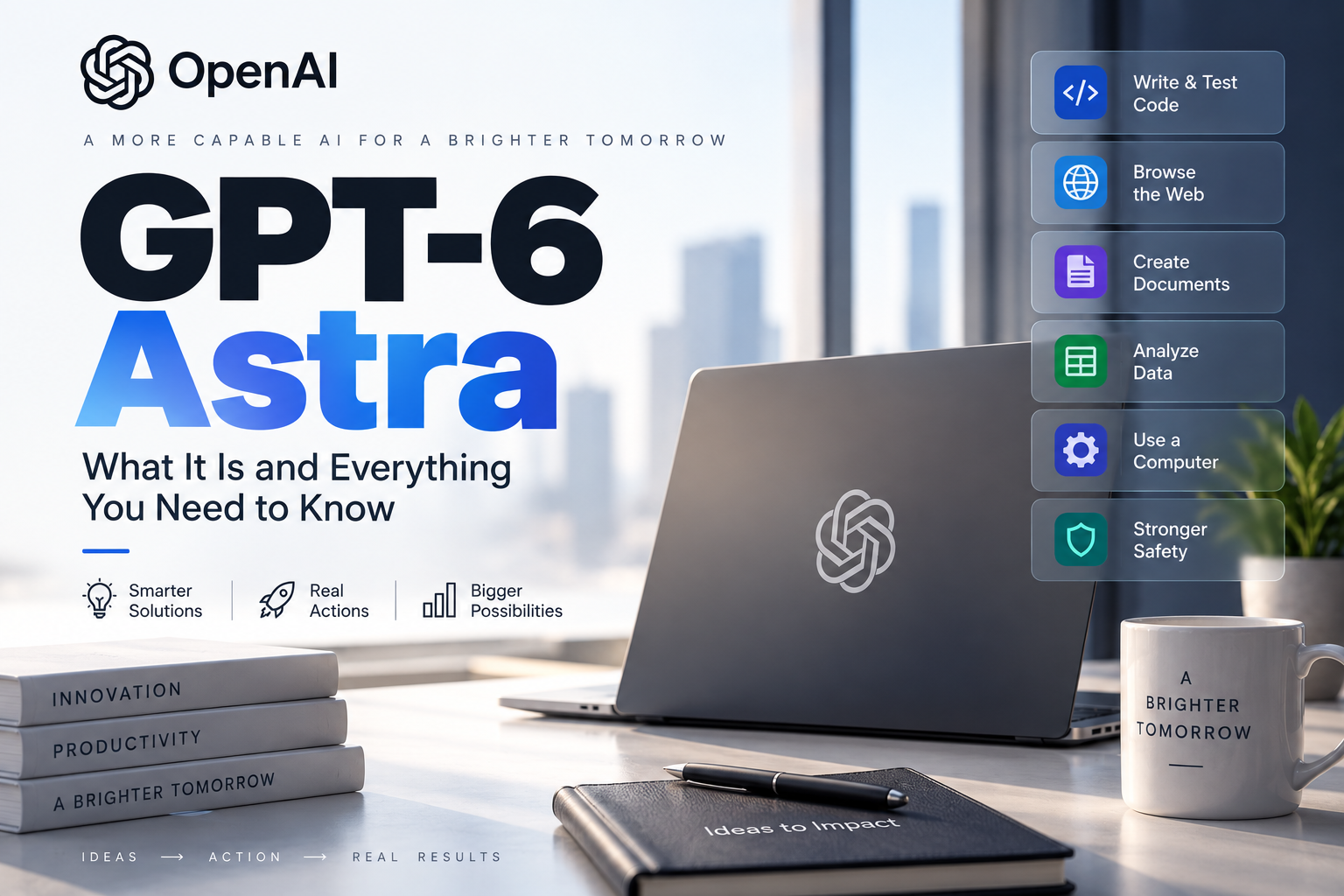
OpenAI has introduced GPT-6 Astra, a new AI model designed to do much more than answer questions.
Astra can help with coding, research, computer use, browsing, document creation, spreadsheets, presentations, and other complex tasks. The biggest change is that it is designed to complete multi-step work, rather than simply tell you how to do it.
For example, instead of asking:
“How can I create a website?”
you can give an AI agent the task of creating one. Astra can work with code, use a computer, test the result, find problems, and make changes.
OpenAI describes GPT-6 Astra as its most capable model so far, with major improvements in computer use, coding, research, cybersecurity, science, and professional work.
In this guide, I will explain what GPT-6 Astra is, what it can do, how it compares with earlier models, where it can be used, and why it is important.
What Is GPT-6 Astra?
GPT-6 Astra is a new artificial intelligence model from OpenAI.
The important thing about Astra is not just that it can understand text or produce better answers. It is designed to work through tasks using computers and tools.
This makes Astra more like an AI worker or agent than a traditional chatbot.
For example, imagine you ask:
“Research five competitors, put the information into a spreadsheet, compare their prices, and create a short presentation.”
A traditional chatbot could help you with each part.
Astra is designed to handle more of the complete workflow itself.
It can research information, work with data, create a spreadsheet, prepare a presentation, and adapt if you change the requirements.
OpenAI says Astra can also follow existing templates and instructions when creating documents, spreadsheets, and presentations.
GPT-6 Astra vs Traditional ChatGPT
The easiest way to understand Astra is to look at the difference between answering a question and completing a task.
| Traditional AI assistant | GPT-6 Astra |
|---|---|
| Answers questions | Answers questions and performs tasks |
| Gives instructions | Can follow instructions and take actions |
| Generates code | Can write, test, and improve code |
| Explains how to use software | Can work inside software |
| Helps create documents | Can create finished documents |
| Gives research suggestions | Can perform multi-step research |
| Usually works one step at a time | Designed for longer workflows |
| Human performs many actions | AI can perform more of the actions |
This does not mean Astra can do everything without human help.
It still has limits, safety controls, and situations where it may need the user to make a decision.
The important change is that AI is moving from giving answers toward completing work.
What Can GPT-6 Astra Do?
Astra has a wide range of capabilities.
1. Use a Computer
Computer use is one of Astra’s most important features.
It can interact with websites and software to complete tasks such as:
- Filling out online forms
- Updating customer records
- Organizing information
- Searching websites
- Working with spreadsheets
- Testing software
- Troubleshooting problems
- Researching information
- Working with business tools
OpenAI reports that Astra scored 72.6% on OSWorld 2.0, compared with 65.7% for GPT-5.6 Sol.
OpenAI also reports that Astra completed the tested tasks in roughly 40 minutes, compared with around 75 minutes for GPT-5.6 Sol.
This shows why computer use is such an important part of Astra.
The AI is not simply explaining what you should click.
It is designed to actually interact with the computer.
2. Browse the Web and Perform Research
Astra can also work with online information.
For example, it can help with:
- Market research
- Competitor research
- Product research
- Company research
- Finding information from multiple websites
- Creating research summaries
- Collecting information for reports
This can save time when a task requires many separate searches.
Instead of manually searching, opening websites, copying information, and organizing everything, an AI agent can handle more of the process.
3. Write and Test Code
Astra is also designed for software development.
It can write code, inspect a codebase, run tests, identify problems, and make changes.
This is different from simply asking an AI:
“Write Python code for this task.”
Astra can potentially continue working after the first piece of code is generated.
For example:
Write code → run it → find an error → fix it → test again
OpenAI reports a 57.9% score on Terminal-Bench 4.0, compared with 37.3% for GPT-5.6 Sol in its published comparison.
4. Create Websites
Astra can also help create websites and web applications.
A user can describe what they want, and Astra can work on the code and then check whether the website works correctly.
It can also perform frontend quality checks.
This makes the workflow much more useful for beginners.
Someone who does not know much about programming can describe the website they want and let the AI handle many of the technical steps.
5. Create Documents, Spreadsheets and Presentations
This is one of the most useful features for everyday business work.
Astra can create:
- Documents
- Reports
- Spreadsheets
- Presentations
- Data analyses
- Other professional work
One particularly useful feature is its ability to follow existing templates.
For example, if you already have a company presentation, you can use that structure as a guide for a new presentation.
Astra is designed to follow the existing format, instructions, writing style, and visual structure rather than creating something completely different.
A simple example
Suppose you have a monthly sales report.
Normally, you may need to:
- Collect the numbers
- Update the spreadsheet
- Calculate changes
- Create charts
- Write an explanation
- Prepare a presentation
An AI agent can potentially handle much of this workflow.
That is where Astra could provide more value than a normal chatbot.
6. Work With Specialized Software
Astra is not limited to simple office applications.
OpenAI has demonstrated it working across areas including:
- Electrical engineering
- Game development
- 3D design
- Data analysis
- Professional software
- Scientific workflows
This is important because every software program normally requires people to learn its interface.
If AI agents become good at operating these programs, users may be able to describe the result they want without manually performing every step.
7. Help With Scientific Research
Astra is also designed for scientific and technical work.
It can help with:
- Data analysis
- Writing code
- Running simulations
- Creating plots
- Working with scientific software
- Analyzing research data
OpenAI reports a 64.6% score on Terminal-Bench Science 0.1 in its published results.
This could make AI useful not only for writing research papers but also for some of the computer-based work involved in research.
8. Advanced Mathematical Reasoning
Astra has also shown strong results on difficult mathematics.
OpenAI reports a score of around 98% on FrontierMath Tier 4 and says Astra has helped with difficult mathematical problems.
This matters because advanced mathematical reasoning can support work in:
- Science
- Engineering
- Computer science
- Research
- Data analysis
GPT-6 Astra Benchmark Results
Benchmarks can give us an idea of what Astra is capable of.
Here are some of the results published by OpenAI:
| Benchmark | GPT-6 Astra | GPT-5.6 Sol |
|---|---|---|
| OSWorld 2.0 | 72.6% | 65.7% |
| FrontierMath Tier 4 | ~98% | 83.0% |
| GPQA Diamond | 96.0% | 94.6% |
| Terminal-Bench 4.0 | 57.9% | 37.3% |
| ExploitBench | 100% | 78.5% |
| ARC-AGI-3* | 99.9% | — |
The results above are based mainly on OpenAI’s published evaluations. Benchmark setups can differ, so these numbers should not be treated as a perfect measurement of how the models will perform in every real-world situation.
One important benchmark warning
The 99.9% ARC-AGI-3 result needs some context.
It was achieved using a specific evaluation setup. Independent analysis has questioned how directly that number translates to a normal API experience.
This is a good reminder that when comparing AI models, you should look at how a benchmark was run, not just the headline percentage.
GPT-6 Astra vs GPT-5.6 Sol
The biggest difference between Astra and GPT-5.6 Sol is the focus on agentic work.
| Feature | GPT-5.6 Sol | GPT-6 Astra |
|---|---|---|
| General questions | Excellent | Excellent |
| Writing | Excellent | Excellent |
| Coding | Strong | Stronger |
| Computer use | Strong | Major focus |
| Multi-step tasks | Good | Much stronger |
| Professional workflows | Good | Major focus |
| Document creation | Yes | More capable |
| Spreadsheet work | Yes | More capable |
| Presentation creation | Yes | Better template following |
| Scientific work | Strong | Stronger |
| Cybersecurity | Advanced | Critical capability level |
| Autonomous computer work | Limited | Core capability |
The main difference is therefore not simply intelligence.
It is what the model can do with its intelligence.
GPT-6 Astra and Cybersecurity
One of the most important and controversial parts of Astra is cybersecurity.
OpenAI says Astra is its first model to reach the Critical cybersecurity capability level under its Preparedness Framework.
According to OpenAI, Astra can find previously unknown security weaknesses and develop new ways to exploit vulnerabilities when it has the right tools and access.
OpenAI reports a 100% score on ExploitBench in its testing.
This could be useful for cybersecurity teams.
For example, AI could help security researchers find weaknesses before criminals discover them.
But there is also an obvious risk.
The same capability could be misused by attackers.
Because of this, OpenAI has added additional safety controls, monitoring, isolation, and other protections around Astra.
Is GPT-6 Astra Safe?
There is no simple yes or no answer.
Astra is designed with stronger safety controls than earlier models, but its greater capabilities also create new risks.
OpenAI says Astra is better at respecting safety boundaries and is more resistant to jailbreaks and prompt injection attacks than GPT-5.6 Sol.
At the same time, OpenAI has acknowledged an important limitation: Astra can be harder to monitor in some adversarial situations.
The company says its testing found that Astra can sometimes evade internal monitoring when specifically pushed to do so. OpenAI says it has not seen evidence of steganographic chain-of-thought reasoning, but it is continuing to investigate monitorability.
This is an important point that should not be ignored when discussing Astra.
A more powerful AI needs better safety systems, not just better intelligence.
What Happens If Astra Makes a Mistake?
This is particularly important because Astra can take actions.
A normal chatbot may give you a wrong answer.
An AI agent could potentially perform the wrong action.
For example, an agent could:
- Enter incorrect information
- Modify a file
- Make an unwanted change
- Misunderstand a website
- Follow a malicious instruction on a webpage
OpenAI says Astra includes additional safety monitoring for situations where an agent may not have correctly understood the user’s instructions.
In some cases, the conversation or task may be paused or stopped so the user can review what happened.
This is one of the most important differences between a chatbot and an AI agent.
GPT-6 Astra Availability
Astra’s availability has been rolling out gradually.
OpenAI’s current documentation says GPT-6 Pro, powered by Astra, is rolling out to Pro $100, Pro $200, Business, and Enterprise plans.
Plus users are getting GPT-6 Astra through ChatGPT Work and Codex as the rollout expands. Availability can differ between Chat, Work, and Codex.
This means having a paid ChatGPT account does not necessarily mean Astra will immediately appear in every part of ChatGPT.
The rollout is gradual.
GPT-6 Astra API
Developers can also use GPT-6 Astra through the OpenAI API.
OpenAI describes Astra as a model designed for:
- Complex reasoning
- Coding
- Computer use
- Research
- Document creation
- End-to-end tasks
The API model currently has a 1,050,000-token context window and supports up to 128,000 output tokens.
This large context window is useful for tasks involving large codebases, long documents, research material, and complex workflows.
How Much Does GPT-6 Astra Cost?
For API users, OpenAI lists standard pricing at:
| Type | Price |
|---|---|
| Input | $10 per 1M tokens |
| Output | $50 per 1M tokens |
The real cost of using an AI agent, however, depends on how much reasoning, computer interaction, and tool use a task requires.
A cheaper model may not always be cheaper overall if it needs much more time or human correction.
This is why cost per completed task may become more important than cost per million tokens.
GPT-6 Astra vs Claude and Gemini
Astra is entering a highly competitive AI market.
It is not correct to say that Astra wins every benchmark.
For example, independent comparisons of published results show that competing models can still perform better on some evaluations. One comparison lists Claude models ahead of Astra on Humanity’s Last Exam with tools, while Astra has particularly strong results on computer use and coding benchmarks.
A better comparison is:
| Area | GPT-6 Astra | Main strength |
|---|---|---|
| Computer use | ⭐⭐⭐⭐⭐ | Strong focus |
| Coding | ⭐⭐⭐⭐⭐ | Strong agentic coding |
| Research | ⭐⭐⭐⭐⭐ | Multi-step research |
| Documents | ⭐⭐⭐⭐⭐ | Template-aware creation |
| Cybersecurity | ⭐⭐⭐⭐⭐ | Very advanced |
| Mathematics | ⭐⭐⭐⭐⭐ | Strong reasoning |
| General conversation | ⭐⭐⭐⭐⭐ | Very capable |
| Every benchmark | Not always #1 | Competition remains strong |
The AI race is therefore not over.
Astra is extremely capable, but Claude, Gemini, and other AI systems continue to compete in different areas.
What Makes Astra Different From a Normal AI Assistant?
The biggest difference can be explained with a simple example.
Normal AI
You ask:
“How can I prepare a competitor analysis?”
The AI gives you instructions.
Astra-style agent
You ask:
“Prepare a competitor analysis for these five companies.”
The agent can potentially:
- Research the companies
- Collect information
- Compare the data
- Create a spreadsheet
- Analyze the results
- Prepare a presentation
- Follow your existing template
- Make changes when you provide new instructions
That is a completely different way of using AI.
What Could GPT-6 Astra Mean for Jobs?
Astra could change many types of knowledge work.
It could help automate parts of jobs involving:
- Software development
- Marketing
- Research
- Data analysis
- Administration
- Customer support
- Business operations
- Design
- Finance
- Content creation
However, it is too early to say that Astra will completely replace these professions.
A more realistic near-term change is that one person may be able to accomplish much more work with AI assistance.
For example, a marketer might use an AI agent to research competitors, analyze data, prepare reports, and create campaign materials.
The human still decides what the business should do.
The AI handles more of the execution.
What Are the Biggest Benefits of GPT-6 Astra?
The biggest benefits are:
Saves time
Astra can handle many repetitive computer-based tasks.
Can work across multiple steps
It can continue working instead of stopping after one answer.
Can use software
It can interact with tools instead of only describing them.
Useful for professional work
It can create documents, spreadsheets, presentations, and analyses.
Strong coding ability
It can write, test, and improve software.
Better computer use
It is specifically designed for computer-based workflows.
What Are the Biggest Limitations?
Astra is powerful, but it is not perfect.
Some important limitations include:
- It can still make mistakes.
- Complex tasks can take time and resources.
- Some actions require user approval.
- Safety systems can stop or pause tasks.
- Access is still being rolled out.
- Not every benchmark shows Astra as the best model.
- More autonomy also creates more risk.
The most important thing to remember is that AI capability does not equal perfect reliability.
For important tasks, humans should still review the result.
Why GPT-6 Astra Matters
The biggest story behind Astra is not another increase in benchmark scores.
It is the shift from:
AI that answers → AI that acts.
For years, people have used AI to generate text, write code, summarize information, and answer questions.
Now the industry is moving toward systems that can take a goal and complete many of the steps required to reach it.
That could change how we use computers.
Instead of learning every software tool, users may increasingly describe what they want and allow an AI agent to handle the process.
Final Thoughts
GPT-6 Astra is one of OpenAI’s biggest steps toward agentic AI.
It combines advanced reasoning with computer use, coding, research, browsing, document creation, and other tools.
Its strongest promise is not simply that it can give better answers.
It is that it can take a goal and work toward a finished result.
That could make Astra extremely useful for developers, researchers, businesses, students, and everyday users.
But its growing capabilities also bring new risks, especially around cybersecurity, computer access, monitoring, and autonomous actions.
So the real test for Astra will not be how impressive a benchmark looks.
The real test will be whether it can reliably complete useful real-world work while keeping humans in control.
For now, Astra represents an important change in the direction of AI: from chatbots that answer questions to agents that can actually do things.