
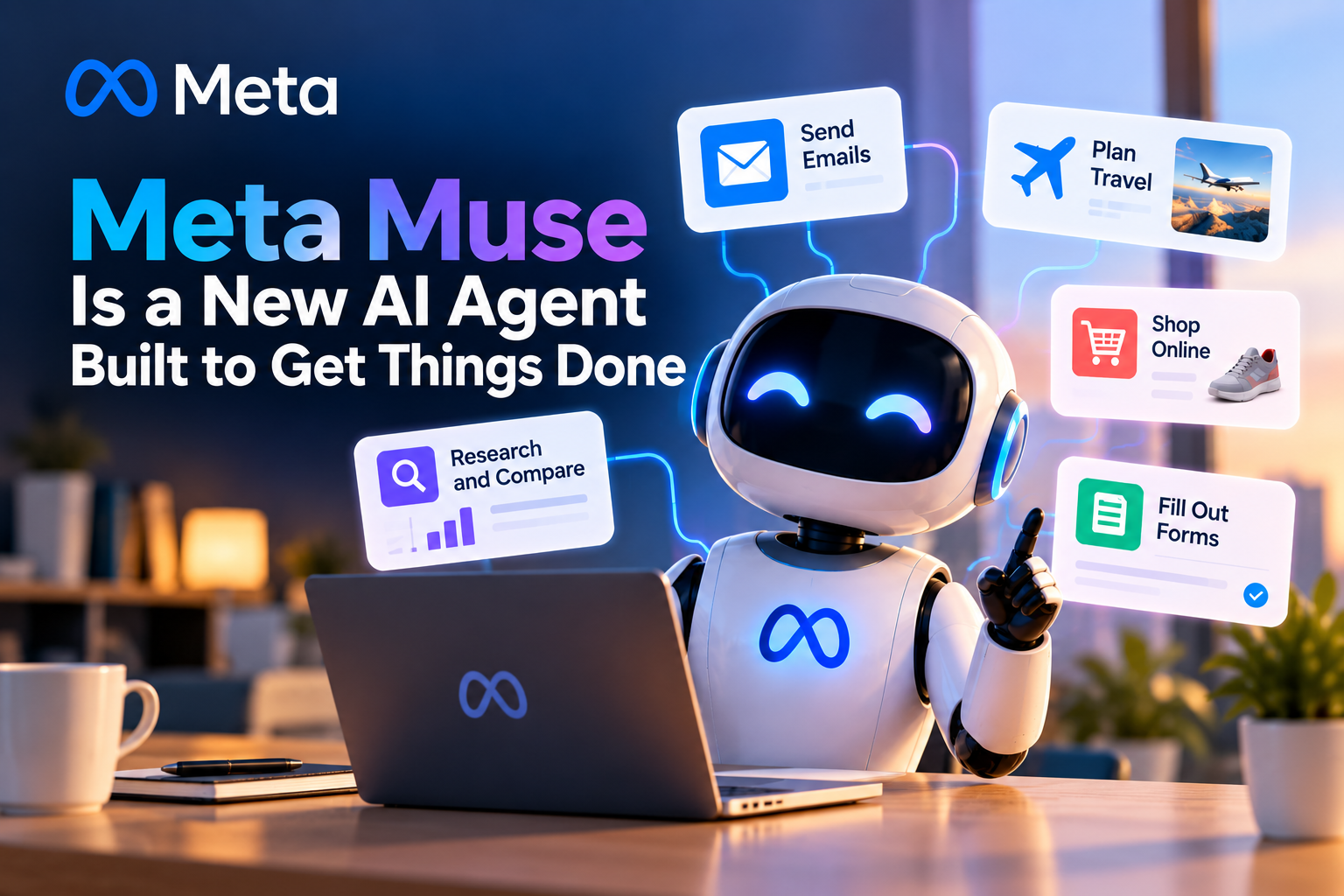
Artificial intelligence has become a regular part of everyday life, but most AI tools still work in a simple way. You ask a question, give an instruction, and the AI gives you an answer. Meta is now working on a different kind of AI experience with Muse, a personal AI agent designed to do more than simply respond to users.
Muse is built around the idea of giving AI more responsibility for completing tasks. Instead of asking the user to manage every step, an AI agent can understand a larger goal, work through different steps, use connected services, and ask for approval when an important action needs to be taken. This could make AI more useful for everyday activities such as email, shopping, travel, research, and online tasks.
What Is Meta Muse?
Meta Muse is a personal AI agent developed by Meta. It is designed to act more like a digital assistant than a traditional chatbot. The user can tell Muse what they want to accomplish, and the system can work through the steps needed to complete the task.
For example, imagine that you want to plan a short trip. A normal chatbot could give you a list of hotels, suggest places to visit, or explain how to book a flight. Muse is designed to go further by helping with the actual process, including researching options, working with websites, filling in information, and helping complete bookings when the user gives permission.
This is the basic idea behind AI agents. Instead of only providing information, the AI can interact with tools and services to help get the work done.
How Is Muse Different From a Normal AI Chatbot?
The biggest difference between a traditional chatbot and an AI agent is the ability to take action.
When you ask a chatbot to write an email, it can generate the text for you. You then have to open your email application, copy the message, choose the recipient, and send it. An AI agent can potentially handle more of those steps itself, while still asking for your approval before sending the final message.
The same idea can apply to shopping. A chatbot can recommend a product based on your requirements, but an AI agent can search different options, compare them, and help complete the purchase. The user can focus on the final decision instead of spending time on every small step.
This makes AI agents different from the AI tools most people have become familiar with over the past few years. The goal is no longer just to make AI better at answering questions. The goal is to make AI capable of completing useful tasks.
What Can Meta Muse Do?
Meta is building Muse to handle a range of everyday activities. The agent is designed to work with connected services and websites so that it can perform tasks instead of simply explaining how users can perform them.
One area where this can be useful is email. Muse can help users manage email-related tasks, prepare messages, and perform other actions when it has the required access. Actions such as sending a message can require the user’s approval, which gives the user an opportunity to check the information before anything is sent.
Travel is another important use case. Planning a trip can involve searching for flights, comparing hotels, checking dates, entering information, and completing bookings. An AI agent can potentially handle many of these smaller tasks as part of one larger request, making the process less time-consuming.
Muse is also designed to help with online shopping. Instead of manually searching through different websites, users can describe what they are looking for and allow the agent to find suitable options. The user can then review the results and approve a purchase when they are ready.
Muse Can Work With Websites and Forms
A major part of making an AI agent useful is allowing it to interact with websites.
Many online tasks are not difficult, but they can take a lot of time. Filling out forms, entering details, comparing information, and moving between different pages can become repetitive, especially when the same type of task has to be completed several times.
Muse is designed to interact with websites and complete some of these steps on the user’s behalf. This could be useful for activities such as travel bookings, online shopping, registrations, and other routine tasks.
The important difference is that the user does not necessarily need to explain every step. They can provide the overall goal and allow the agent to work through the process.
Muse Can Handle Longer Tasks
Another interesting part of the AI agent concept is the ability to work on tasks that involve several steps.
A normal chatbot usually waits for the user to send the next message. If you want it to perform another task, you need to ask again. An AI agent can be designed to continue working through a task without requiring constant instructions.
For example, you could ask Muse to research several travel options that match your requirements. Instead of sitting in front of the screen and giving instructions at every stage, you could allow it to work through the research and return when it has something useful to show you or when it needs your approval.
This could be particularly useful for tasks that require research, comparison, and several actions before reaching a final result.
Muse Can Remember Your Preferences
A personal assistant becomes more useful when it understands your preferences. Muse is designed to remember relevant information from previous interactions and use it when helping with future tasks.
For example, if you regularly ask for vegetarian restaurant recommendations, remembering that preference can save you from explaining it every time. Similarly, information about your shopping preferences, travel requirements, or work habits could help the agent provide more relevant assistance.
This is one of the areas where personal AI agents could become different from general-purpose chatbots. The more useful information an assistant can remember, the less information the user needs to repeat.
However, this also makes privacy and control more important. Users need to understand what information an AI can remember and how that information is used.
Meta Is Connecting Muse With Other Services
An AI agent becomes much more useful when it can work with the services people already use. Meta is therefore building connections between Muse and different services across areas such as shopping, travel, productivity, documents, and work.
These connections allow the agent to move beyond a simple conversation. Instead of giving the user instructions for using another service, Muse can potentially interact with that service and perform part of the task.
This could eventually change how people use software. Today, a person might open several different applications to complete one job. In the future, they could potentially tell an AI agent what they want and allow it to work with those applications in the background.
User Approval Is Still Important
Giving an AI the ability to perform actions creates an obvious question: what happens if the AI makes a mistake?
This is why user approval is an important part of AI agents. There is a big difference between suggesting a product and purchasing it, or between writing an email and sending it.
Muse is designed to allow users to remain involved in important decisions. Some actions can require approval before they are completed, particularly when they involve purchases, communication, or other sensitive activities.
This approach creates a balance between automation and control. The AI can handle repetitive work, while the user remains responsible for decisions that have important consequences.
Security Is a Major Part of AI Agents
AI agents need more access than traditional chatbots. A chatbot can often work with the information that a user provides directly in a conversation. An agent may need to interact with websites, applications, accounts, and other services.
This creates additional security risks.
Meta has developed a separate environment for Muse where the agent can perform tasks. The company is also working on security systems designed to control what Muse can access and which actions it can perform.
This type of security will become increasingly important as AI agents become more powerful. The more control an AI has over a person’s digital life, the more important it becomes to limit that access and protect sensitive information.
What About Privacy?
Privacy is one of the biggest questions surrounding personal AI agents.
An AI that can help manage email, shopping, travel, and other activities may have access to information that reveals a lot about a person’s daily life. Users therefore need clear controls over which services the AI can access and what it can do with that access.
Meta says users can control the services connected to Muse and manage the permissions given to the agent. The company is also working on additional security features designed to protect information used by the system.
For AI agents to become widely accepted, users will need to trust them. Convenience alone will not be enough. People need to feel that they remain in control of their accounts, information, money, and important decisions.
Muse Is Also Coming to Meta AI Glasses
Meta is also bringing its AI assistant technology to its smart glasses. This could make the idea of a personal AI agent even more interesting because users would not always need to open a phone or computer to interact with the system.
Imagine looking at a product while shopping and asking your AI assistant what it is or whether there are similar options. Instead of taking a photograph, opening a search engine, typing a description, and checking different websites, the assistant could potentially handle much of that process.
This type of interaction could make AI feel more natural because the assistant would be available in the user’s surroundings rather than being limited to a particular application.
Why AI Agents Are Becoming Important
The development of Muse is part of a larger change in the AI industry. The first major wave of consumer AI focused heavily on chatbots and content generation. People used AI to write text, answer questions, summarize information, create images, and generate code.
The next stage is increasingly focused on AI that can use tools and perform tasks.
Instead of asking an AI to explain how something works, users may increasingly ask it to do the work. Instead of requesting a list of products, they may ask it to find the right product. Instead of asking how to organize a trip, they may ask the AI to help organize the entire trip.
This shift could make AI much more valuable for everyday work.
Could AI Agents Replace Some Apps?
AI agents are unlikely to make every application unnecessary, but they could change how people interact with those applications.
Today, users often think about the application they need before starting a task. If they want to send an email, they open an email application. If they want to book a hotel, they open a travel website. If they want to buy something, they open a shopping website.
With AI agents, the user may increasingly think about the result instead.
For example, instead of thinking about which websites to use, they could simply say, “Find me a hotel in Mumbai for two nights within my budget.” The agent could then work with the relevant services to find suitable options.
The applications would still exist, but the AI could become the interface that connects the user with them.
What Are the Risks of AI Agents?
AI agents can save time, but giving them more control also creates new risks.
One problem is misunderstanding the user’s instructions. A person might ask an AI to find the cheapest flight, while actually caring more about travel time or convenience. If the agent focuses only on price, it could choose an option that technically meets the request but does not match the user’s real preference.
There are also concerns around incorrect information, accidental actions, privacy, security, and unauthorized access. These issues become more important when an AI is able to make purchases, send messages, or interact with other services.
For this reason, AI agents will need strong permission systems and clear explanations of what they are doing. Users should also have the ability to stop an action or change the agent’s access when necessary.
Who Can Benefit From Meta Muse?
Personal AI agents could be useful for many different types of users. Students could use them to organize research and manage repetitive tasks, while professionals could use them for email, scheduling, research, and administrative work.
Business owners could potentially use AI agents to research products, organize information, and handle routine online tasks. Travelers could use them to plan trips and compare options, while everyday users could use them for shopping, planning, and other activities.
The biggest potential benefit is not that AI can do one impressive task. It is that AI can combine several small tasks into one workflow and reduce the amount of manual work required from the user.
The Future of Personal AI Assistants
Meta Muse represents a broader change in the way people may interact with artificial intelligence.
For years, the main question was whether AI could understand and answer human questions. Now the focus is shifting toward whether AI can understand a goal and take the necessary steps to achieve it.
That is a much bigger challenge.
An effective AI agent needs to understand instructions, make decisions, use different tools, deal with unexpected situations, protect user information, and know when it should ask the user for help.
If these systems become reliable enough, they could become a regular part of everyday digital life.
Conclusion
Meta Muse is Meta’s attempt to move personal AI beyond traditional chatbot conversations. The agent is designed to help users complete tasks involving email, shopping, travel, online forms, research, and other everyday activities while keeping users involved in important decisions.
The technology is still developing, and there are serious questions around privacy, security, accuracy, and control. However, the direction is clear. AI companies are increasingly building systems that can use software and online services rather than simply telling people how to use them.
The biggest change could be the way we think about AI itself. Instead of asking, “What can AI tell me?”, people may increasingly ask, “What can AI do for me?”
That shift from answering to doing is what makes AI agents such as Meta Muse an important development to watch.