
Artificial Intelligence (AI) has become a part of our daily lives. Whether you use ChatGPT, Google Gemini, Claude, Microsoft Copilot, or another AI tool, they all rely on prompts to understand what you want.
Many people think that AI always knows the right answer. In reality, the quality of the response depends a lot on the quality of the prompt. A clear and well-written prompt helps AI generate more accurate, useful, and reliable answers.
This practice is known as prompt engineering—the process of writing effective instructions that help AI understand your request better.
In this guide, you’ll learn the best practices for creating prompts that improve AI responses. These tips are useful whether you’re a student, content writer, developer, marketer, business owner, or someone who uses AI for everyday tasks.
What Is a Prompt?
A prompt is the instruction or question you give to an AI model.
For example:
- “Write a blog about electric cars.”
- “Summarize this article in 100 words.”
- “Create a Python program to sort numbers.”
The AI reads your prompt, understands your request, and generates a response based on its training and the information you provide.
Think of a prompt as giving directions to another person. If your directions are clear, they are more likely to complete the task correctly.
Why Are Good Prompts Important?
A good prompt helps AI:
- Understand exactly what you need.
- Reduce misunderstandings.
- Produce more accurate answers.
- Save time by avoiding multiple revisions.
- Generate consistent results.
- Follow your preferred style and format.
Poor prompts often lead to incomplete, confusing, or incorrect responses.
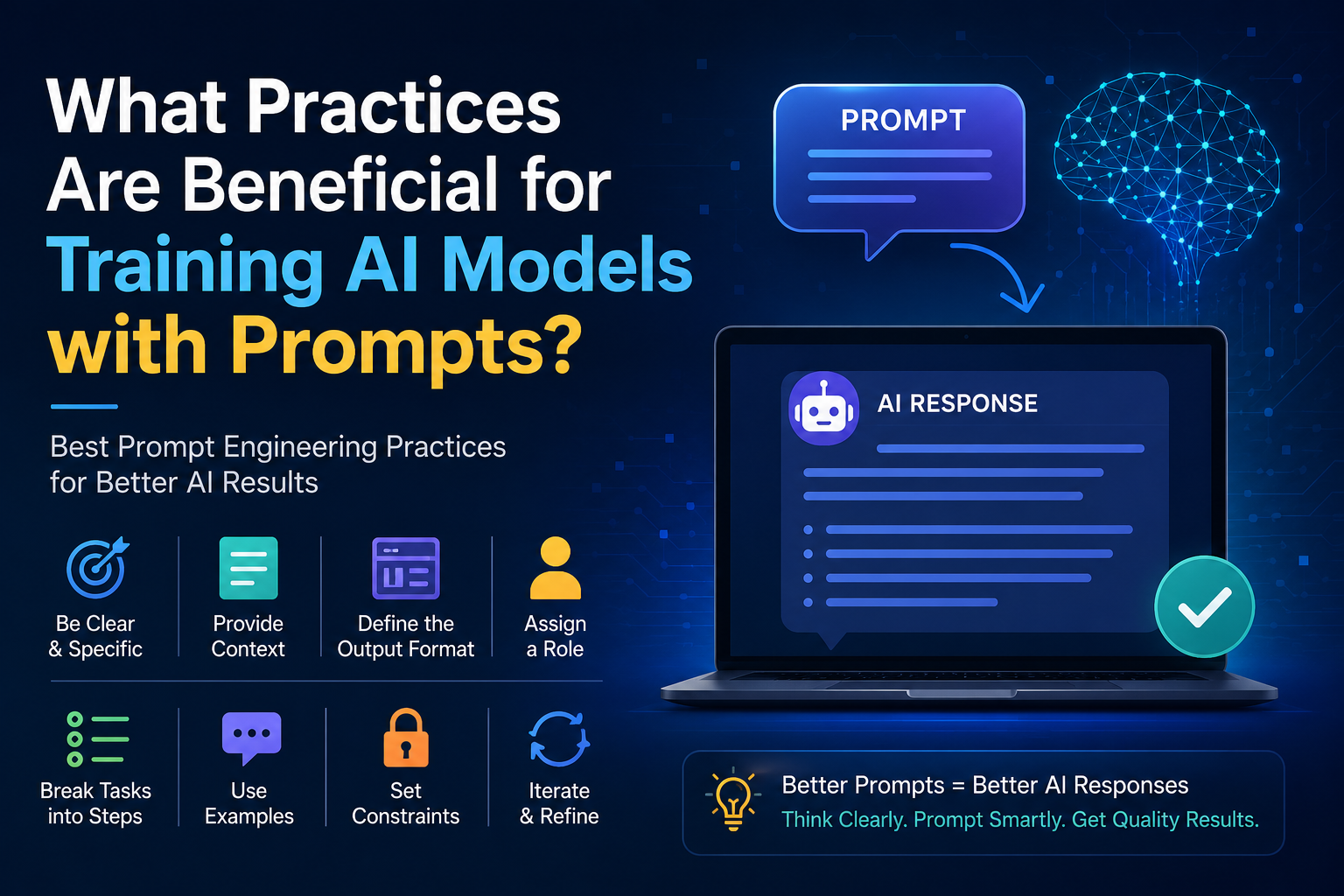
Best Practices for Training AI Models with Prompts
1. Be Clear and Specific
The biggest mistake people make is writing vague prompts.
Poor Prompt
Write about AI.
The AI doesn’t know:
- Which type of AI?
- Who is the audience?
- How long should it be?
- What style should it use?
Better Prompt
Write a 1,200-word beginner-friendly blog explaining how AI helps small businesses. Include examples, benefits, challenges, and a conclusion.
The second prompt gives clear instructions, making it much easier for AI to generate useful content.
Tip: Always include the topic, purpose, audience, and expected outcome.
2. Provide Enough Context
Context helps AI understand the situation.
Instead of saying:
Write an email.
Try:
Write a professional email to a client explaining that their project delivery will be delayed by two days due to technical issues.
Now the AI understands:
- Who the email is for.
- Why it is being written.
- What information should be included.
The more relevant context you provide, the better the response.
3. Define the Output Format
Tell AI exactly how you want the answer.
For example:
- Bullet points
- Numbered list
- Blog post
- FAQ
- Table
- JSON
- Markdown
- Step-by-step guide
Example
Instead of:
Explain cloud computing.
Try:
Explain cloud computing using headings, bullet points, and real-life examples suitable for beginners.
This creates a much more organized response.
4. Assign a Role
AI performs better when it knows the role it should play.
Examples include:
- SEO Expert
- Software Developer
- Teacher
- Financial Advisor
- Doctor (for educational purposes)
- Marketing Consultant
- Career Coach
Example
Act as a cybersecurity expert and explain phishing attacks in simple English.
The AI adjusts its tone and knowledge based on the assigned role.
5. Break Large Tasks into Smaller Steps
Complex prompts often produce mixed results.
Instead of asking AI to do everything at once, divide the work into stages.
Example
Step 1: Create an outline.
Step 2: Expand each heading.
Step 3: Add examples.
Step 4: Improve readability.
Step 5: Optimize for SEO.
This approach usually gives better quality results.
6. Include Examples
Examples help AI understand exactly what you expect.
Suppose you want product descriptions.
Instead of simply asking:
Write product descriptions.
Provide an example.
Example
Input
Wireless Mouse
Output
A comfortable wireless mouse with silent clicks, long battery life, and ergonomic design, perfect for work and gaming.
Now AI understands the writing style you want.
7. Specify Constraints
Constraints tell AI what limits to follow.
Examples include:
- Word count
- Reading level
- Tone
- Language
- Audience
- Number of headings
- SEO requirements
Example
Write an 800-word blog in simple English for beginners using short paragraphs and include five FAQs.
The more specific your requirements, the more consistent the output.
8. Use Positive Instructions
Instead of focusing on what AI should avoid, tell it what it should do.
Less Effective
Don’t make it boring.
Better
Write in a friendly and engaging style using simple examples.
Positive instructions usually produce better results.
9. Refine Your Prompt
The first prompt doesn’t have to be perfect.
Professional AI users often improve their prompts several times.
For example:
First Prompt
Write a blog about AI.
Second Prompt
Write a beginner-friendly blog with headings.
Third Prompt
Add real-world examples and FAQs.
Each improvement produces better content.
Prompt engineering is an ongoing process of testing and refining.
10. Separate Instructions from Data
If you’re providing a long article or document, clearly separate your instructions from the content.
Example:
Instruction
Summarize the following article in five bullet points.
Article
(Paste the article here.)
This helps AI understand which part contains instructions and which part contains information.
11. Ask AI to Think Before Answering
For complex tasks, ask AI to analyze the problem first.
Example:
Compare WordPress, Webflow, and Wix before recommending the best platform for a beginner blogger.
This encourages a more thoughtful response rather than a quick answer.
12. Keep Prompts Simple
Many beginners believe longer prompts are always better.
That’s not true.
A prompt should contain all the necessary information without unnecessary details.
Good prompts are:
- Clear
- Direct
- Easy to understand
- Well organized
Avoid writing confusing or repetitive instructions.
13. Tell AI Who the Audience Is
Knowing the audience helps AI choose the right language and examples.
Examples:
- For children
- For college students
- For beginners
- For business owners
- For software developers
- For senior managers
Example
Explain blockchain technology to a 12-year-old using simple examples.
The response will be much easier to understand.
14. Mention the Desired Tone
Different situations require different writing styles.
Examples include:
- Professional
- Friendly
- Formal
- Casual
- Motivational
- Educational
- Conversational
Example
Write a friendly LinkedIn post encouraging people to learn AI skills.
The tone becomes more suitable for social media.
15. Ask AI to Review Its Work
You can improve quality by asking AI to check its own response.
For example:
Review your answer for grammar mistakes, factual errors, and readability before providing the final version.
This simple step often results in cleaner and more polished content.
Common Prompt Mistakes to Avoid
Many users unknowingly make these mistakes:
- Writing very short and unclear prompts.
- Giving conflicting instructions.
- Forgetting to mention the audience.
- Not specifying the desired format.
- Expecting perfect results from the first attempt.
- Providing too little context.
- Using vague words like “good” or “better” without explaining what they mean.
Avoiding these mistakes will significantly improve AI-generated responses.
Example of a Strong Prompt
Instead of writing:
Write about digital marketing.
Write:
Act as an experienced digital marketing expert. Write a 1,500-word beginner-friendly blog explaining digital marketing in simple English. Include headings, examples, benefits, challenges, best practices, FAQs, and a conclusion. Use short paragraphs and optimize the article for SEO.
Notice how the second prompt gives AI much more useful information.
Final Thoughts
Prompt engineering is one of the most valuable skills for anyone using AI today. A well-written prompt helps AI understand your request, produce better results, and save time by reducing the need for repeated edits.
The best prompts are clear, specific, and well-structured. They include enough context, define the desired format, identify the target audience, and provide any necessary examples or constraints.
As AI continues to evolve, learning how to write effective prompts will become an essential skill for students, professionals, businesses, and content creators alike. By following the best practices shared in this guide, you can unlock the full potential of AI tools and consistently generate high-quality, reliable, and useful responses.
Frequently Asked Questions (FAQs)
1. What is prompt engineering?
Prompt engineering is the process of writing clear and effective instructions that help AI models generate accurate and useful responses.
2. Why are prompts important for AI?
Prompts guide the AI by explaining the task, context, format, and expectations, leading to better-quality answers.
3. Can better prompts improve AI accuracy?
Yes. Clear, detailed, and well-structured prompts often produce more accurate, relevant, and consistent results.
4. Do longer prompts always produce better answers?
No. The best prompts include enough detail to explain the task but avoid unnecessary or repetitive information.
5. Who should learn prompt engineering?
Anyone who uses AI regularly—including students, writers, marketers, developers, educators, researchers, and business professionals—can benefit from learning prompt engineering.