
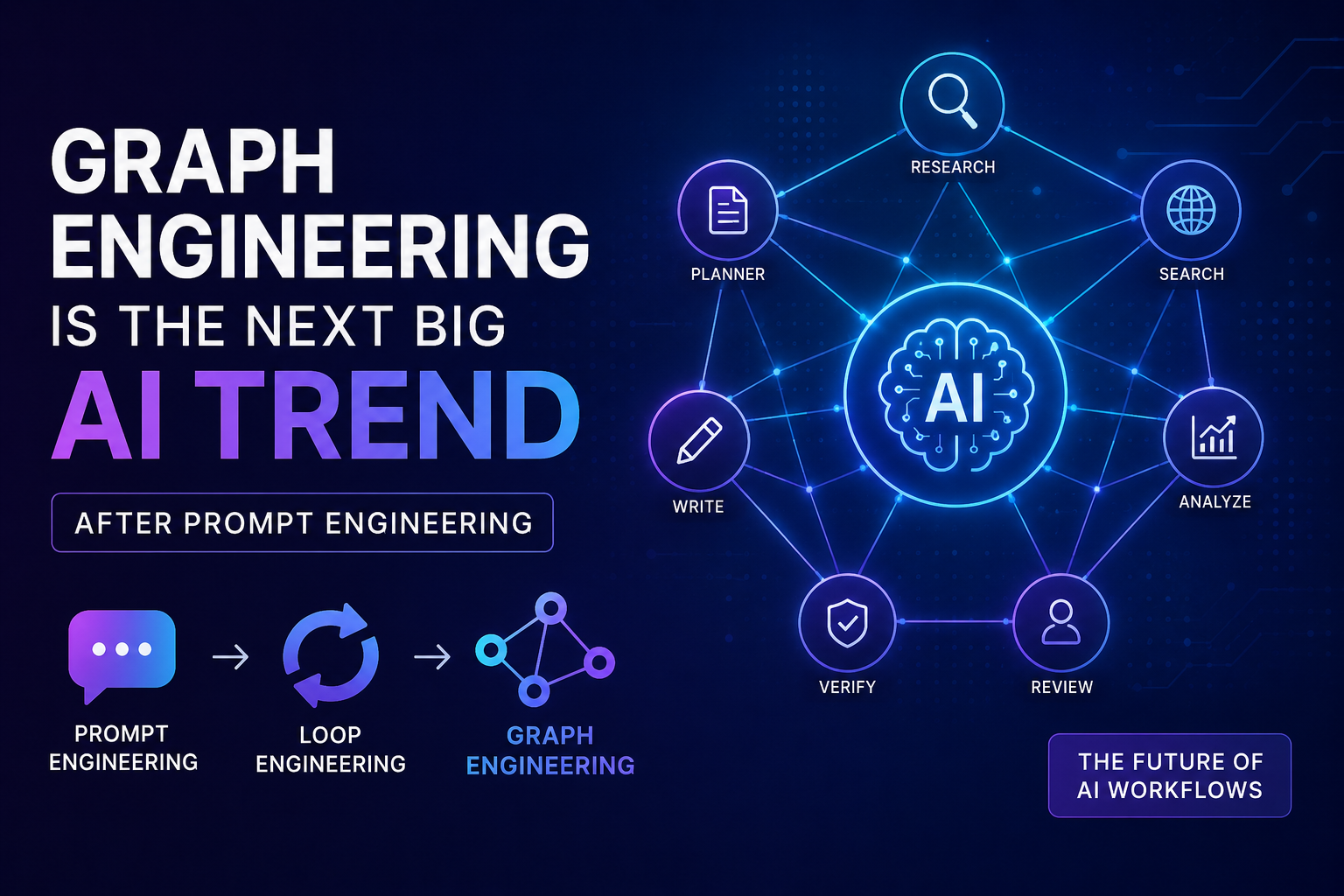
The AI world is changing very quickly. First, we heard a lot about prompt engineering. Then AI agents and loop-based systems started getting more attention. Now, another term is appearing in discussions about the future of AI development: Graph Engineering.
The basic idea is simple. Instead of asking one AI model to complete an entire task, developers can build a system where different AI agents, tools, and processes work together. These different parts are connected to create a larger workflow.
What Is Graph Engineering?
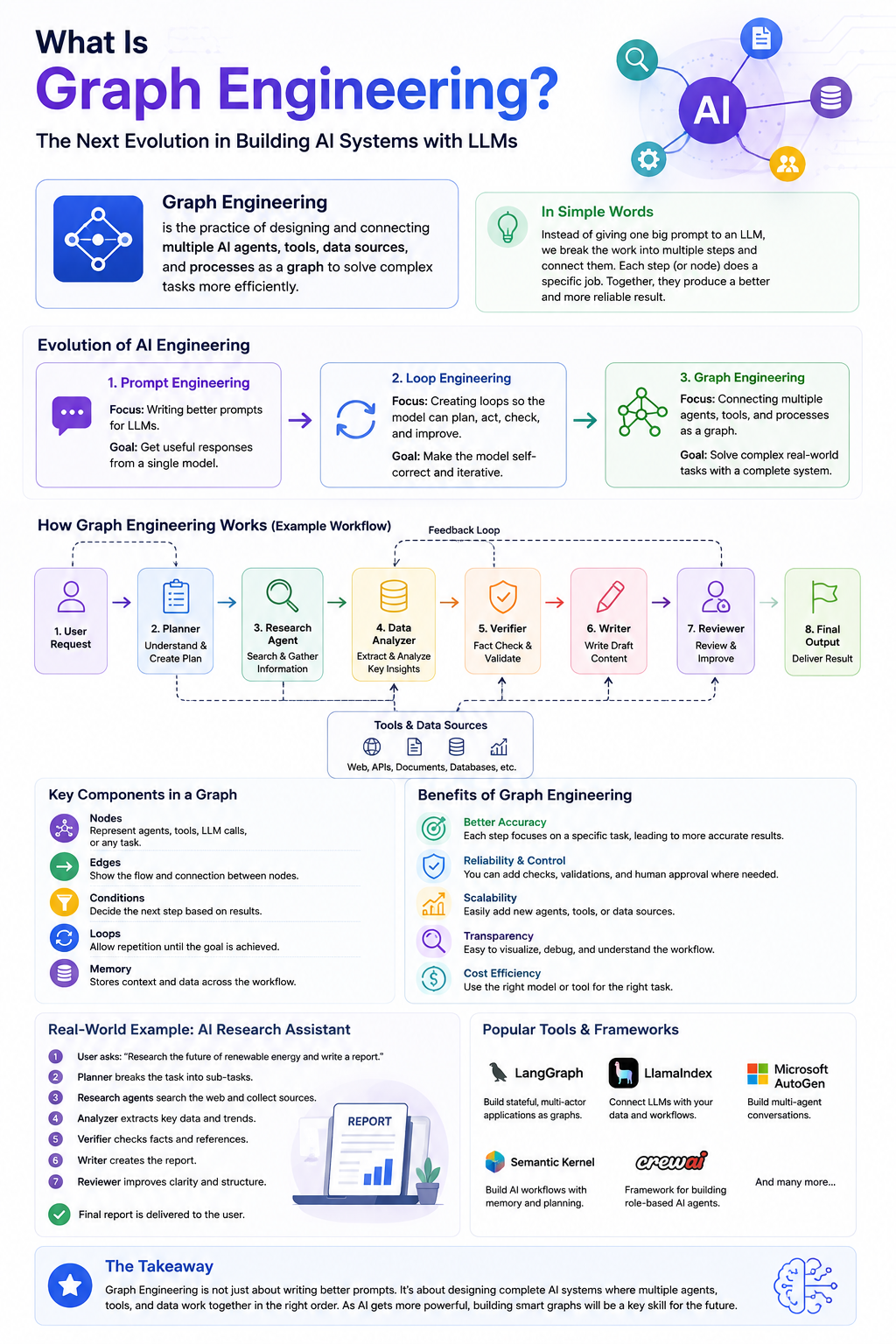
Graph Engineering is a way of designing AI systems by connecting different tasks and AI agents.
For example, imagine that you ask an AI system to research a company and prepare a report. One AI agent could search for information, another could check the information, another could analyze the data, and another could write the report. A final agent could review the report before it is delivered.
All these steps are connected. The system decides what should happen next based on the result of each step. This connected structure is why the word “graph” is used.
In simple terms, Prompt Engineering focuses on the instructions you give to AI, while Graph Engineering focuses on how the whole AI workflow is designed.
How Graph Engineering Is Different From Prompt Engineering
Prompt engineering became popular because better instructions could produce better AI responses. For example, you might tell an AI model to explain a technical topic in simple English, provide examples, and keep the answer under 1,000 words.
That approach works well for many tasks. But more complicated tasks may require several steps.
Imagine asking AI to research a topic, find reliable sources, compare information from different websites, analyze the data, write an article, and check the final article for mistakes.
Giving all of these instructions in one large prompt can become difficult.
A graph-based system can divide the work into smaller parts. Each part can have its own instructions, tools, and checks.
This makes the overall process easier to manage.
What Is Loop Engineering?
Another idea that has gained attention with the growth of AI agents is Loop Engineering.
A loop allows an AI agent to repeat a task when necessary. Instead of producing an answer once and stopping, the agent can check its work and try again.
For example, a coding agent may write some code and run it. If the code produces an error, the agent can identify the problem, change the code, and run it again. It can continue this process until the result meets the required conditions.
This creates a simple cycle of planning, action, checking, and improvement.
Graph Engineering can build on this idea. A graph can contain several agents, and some of those agents can have their own loops.
Why Graph Engineering Is Getting Attention
AI systems are becoming more capable. They can now search for information, use external tools, work with files, write code, analyze data, and perform many other tasks.
But one AI agent does not always need to do everything.
A research agent may be better at finding information. A coding agent may be better at writing and testing code. Another agent may be designed to check facts or review the final result.
Connecting these different capabilities can create a more powerful system.
This is one reason graph-based AI workflows are becoming an interesting area for developers.
A Simple Example of Graph Engineering
Consider an AI system that creates a research report.
The first part of the system could understand the user’s request and create a plan. The next part could search for information from different sources. Another part could compare those sources and identify important facts.
The information could then be passed to an analysis system. After that, a writing agent could prepare the report. Finally, a review agent could check the report before it reaches the user.
If one step fails, the system could send the task back to an earlier step instead of starting everything again.
This is the important idea behind a graph-based workflow. The system is not simply generating one answer. It is managing a complete process.
Graph Engineering Is Not Only About Multiple AI Agents
Graph Engineering does not necessarily mean connecting many AI models.
A graph can also contain normal software tools, databases, APIs, search systems, documents, and human approval steps.
For example, an AI agent could create a financial report, but the system could require a human to approve the report before it is sent to a customer.
This type of structure can be useful for businesses because it gives them more control over what AI is allowed to do.
It can also make it easier to identify where something went wrong.
Tools Are Already Moving Toward Graph-Based AI
The idea behind Graph Engineering is not completely new.
AI development frameworks such as LangGraph are already designed to help developers create workflows where different AI steps, tools, and agents can interact with each other.
Researchers are also exploring ways to represent prompts and AI workflows as connected graphs. A 2026 research paper on prompt graph engineering describes prompts as components that can be organized into executable graph structures rather than treating them only as individual blocks of text.
This does not mean that Graph Engineering has already become a standard term across the AI industry. The terminology is still developing, and different people may use it in slightly different ways.
However, the underlying idea is becoming increasingly important as AI applications become more complex.
Does Graph Engineering Replace Prompt Engineering?
No. Prompt engineering is not going away.
Instead, these ideas can work together.
Prompt engineering helps developers create better instructions for individual AI tasks. Loop engineering can help an AI agent check and improve its work. Graph engineering can connect different tasks, agents, tools, and processes into one larger system.
A future AI application could use all three.
This means that developers may need to think beyond writing a good prompt. They may also need to understand how the entire AI system should operate.
What Could Happen Next?
The next stage could be even more interesting.
AI systems may eventually be able to decide how a task should be divided and which tools or agents should be used. Instead of developers manually creating every possible path, an AI planner could create a workflow based on the user’s request.
For example, if someone asks an AI system to analyze a company’s business performance, the system could decide that it needs financial data, market information, calculations, and a final review.
It could then create the appropriate workflow automatically.
However, this also creates new challenges. Developers will need to think about security, cost, reliability, permissions, and human oversight. Giving an AI system more control over its own workflow also means giving developers more responsibility for controlling that system.
Is Graph Engineering the Future of AI Development?
It is too early to say that Graph Engineering will officially become the next major AI engineering discipline.
The term is still new, and there is no single definition that everyone follows.
But the underlying trend is clear. AI development is moving beyond simple chatbot conversations. Developers are increasingly building systems where agents can use tools, work through multiple steps, check their results, and interact with other agents and software.
That makes graph-based thinking increasingly useful.
Prompt engineering taught us how to communicate better with AI. Loop-based systems showed how AI can repeatedly work toward a goal. Graph Engineering takes the idea further by looking at how the different parts of an AI system can work together.
For now, Graph Engineering is still an emerging concept. But as AI agents become more powerful and more independent, designing the complete AI workflow could become just as important as writing the perfect prompt.