
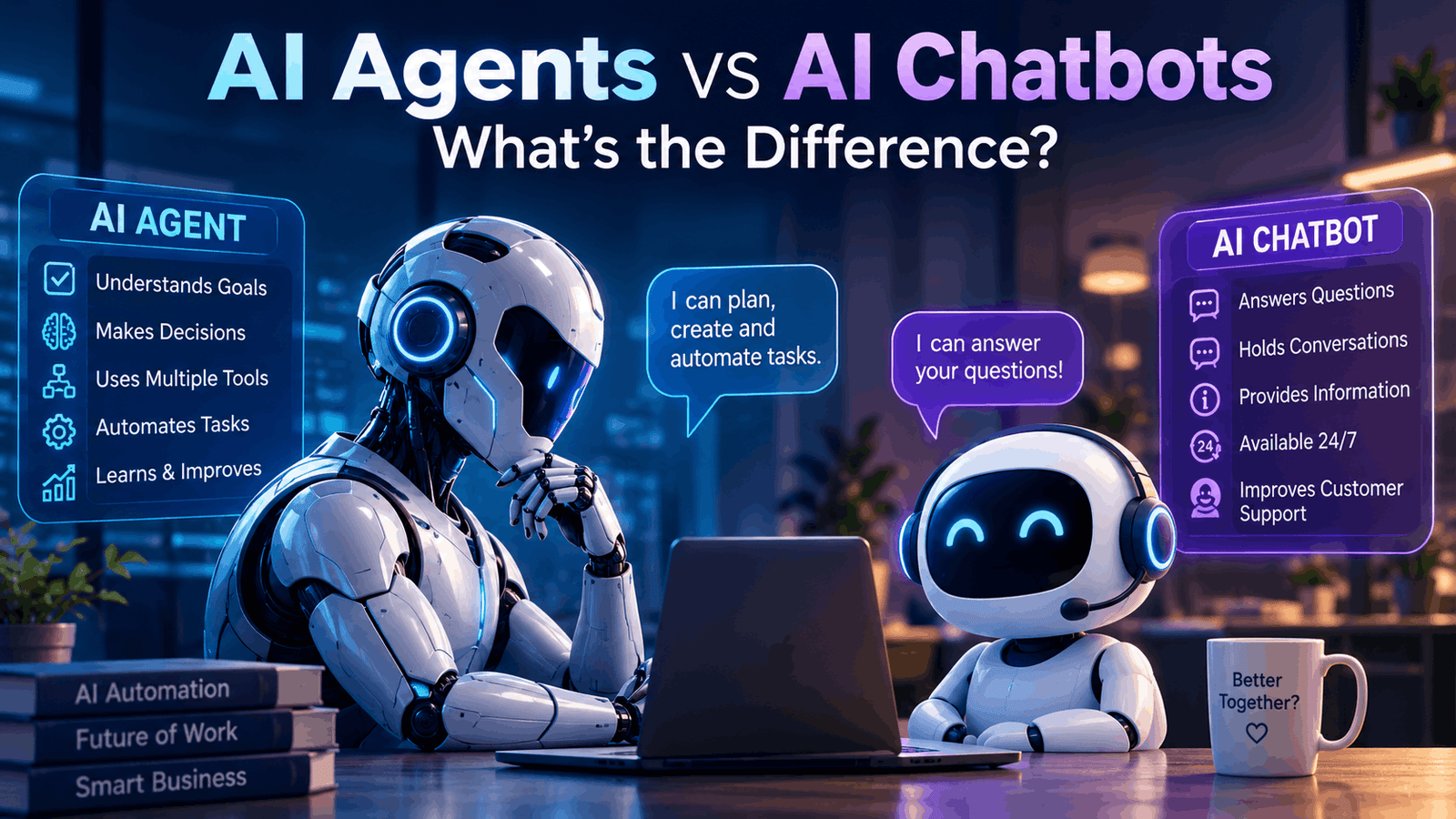
Artificial Intelligence (AI) is changing how people work, shop, learn, and communicate. Two of the most common AI technologies you will hear about are AI chatbots and AI agents. Many people think they are the same, but they are actually very different.
A chatbot is mainly designed to answer questions and have conversations. An AI agent can go much further—it can understand goals, make decisions, use different tools, and complete tasks with little or no human help.
In this guide, you’ll learn the key differences between AI agents and AI chatbots, their features, real-world examples, advantages, and which one is the right choice for your business.
What Is an AI Chatbot?
An AI chatbot is software that interacts with users through text or voice. Its main purpose is to answer questions, provide information, and help users complete simple tasks.
Modern AI chatbots use Natural Language Processing (NLP) and Large Language Models (LLMs) to understand what people are saying and respond naturally.
Common Uses of AI Chatbots
- Customer support
- Answering FAQs
- Booking appointments
- Product recommendations
- Website assistants
- Educational support
- Internal company help desks
For example, if you visit an online shopping website and ask:
“Where is my order?”
The chatbot checks your order status and gives you the latest update. If the question becomes too complex, it may transfer you to a human support agent.
What Is an AI Agent?
An AI agent is a more advanced AI system that can understand a goal and take multiple actions to achieve it.
Instead of simply answering questions, AI agents can:
- Plan tasks
- Make decisions
- Use external tools
- Access databases
- Browse websites
- Write code
- Analyze files
- Automate workflows
- Learn from previous actions
Think of an AI agent as a digital assistant that can actually perform work, not just talk.
For example, imagine you say:
“Find the cheapest flight to Dubai next month, compare hotels, prepare a travel plan, and email me the details.”
An AI agent can complete the entire process automatically instead of only explaining how to do it.
AI Chatbot vs AI Agent: Quick Comparison
| Feature | AI Chatbot | AI Agent |
|---|---|---|
| Main Purpose | Answer questions | Complete tasks |
| Conversation | Yes | Yes |
| Planning | Very limited | Advanced |
| Decision Making | Basic | Intelligent |
| Uses Multiple Tools | Usually no | Yes |
| Memory | Limited | Can remember context |
| Automation | Simple | Complex |
| Works Independently | No | Yes |
| Handles Multi-Step Tasks | Limited | Excellent |
How AI Chatbots Work
AI chatbots follow a simple workflow:
- User asks a question.
- Chatbot understands the request.
- It searches its knowledge or connected database.
- It generates a response.
- User receives the answer.
Most chatbot conversations end after the response is given.
Example
Customer:
“What time does your store open?”
Chatbot:
“Our store opens at 9:00 AM from Monday to Saturday.”
The chatbot successfully answers the question but does not take further action.
How AI Agents Work
AI agents have a much more advanced workflow.
Instead of only answering, they:
- Understand the goal.
- Break it into smaller tasks.
- Decide the best order.
- Use different tools.
- Check results.
- Make improvements if needed.
- Complete the final objective.
Example
User:
“Create a social media campaign for my new product.”
The AI agent may:
- Research competitors
- Analyze customer trends
- Write social media posts
- Create images
- Generate hashtags
- Schedule posts
- Track engagement
- Prepare performance reports
This is much more than a normal chatbot can do.
Main Differences Between AI Agents and AI Chatbots
1. Purpose
Chatbots focus on conversations.
AI agents focus on completing goals.
2. Intelligence
Chatbots mainly respond to user messages.
AI agents analyze situations, make decisions, and adapt their actions.
3. Automation
Chatbots perform simple tasks.
AI agents automate complete workflows.
4. Tool Usage
Most chatbots only answer questions.
AI agents can use:
- Calendars
- Databases
- CRM software
- Search engines
- APIs
- Cloud applications
5. Memory
Many chatbots have limited memory during a conversation.
AI agents often remember previous tasks, user preferences, and ongoing projects.
6. Problem Solving
Chatbots answer one question at a time.
AI agents solve larger problems by breaking them into multiple steps.
Real-World Examples of AI Chatbots
Many businesses already use AI chatbots every day.
Examples include:
- Website customer support
- Banking assistants
- Food ordering bots
- Hospital appointment booking
- Airline customer service
- University admission support
These bots help customers quickly without requiring human staff for every request.
Real-World Examples of AI Agents
AI agents are becoming popular in many industries.
Examples include:
Marketing
- Write blog posts
- Schedule campaigns
- Analyze SEO
- Track website traffic
Sales
- Find potential customers
- Send follow-up emails
- Update CRM systems
- Prepare sales reports
Software Development
- Write code
- Test software
- Fix bugs
- Deploy applications
Finance
- Analyze expenses
- Generate reports
- Detect unusual transactions
- Prepare forecasts
Human Resources
- Screen resumes
- Schedule interviews
- Answer employee questions
- Prepare onboarding documents
Advantages of AI Chatbots
AI chatbots offer many benefits.
1. Available 24/7
Customers receive instant answers anytime.
2. Lower Support Costs
Businesses need fewer human agents for simple questions.
3. Faster Responses
Most questions are answered within seconds.
4. Better Customer Experience
Customers don’t need to wait in long queues.
5. Easy to Deploy
Many chatbot platforms require little coding.
Advantages of AI Agents
AI agents provide even greater value.
1. Save Time
They complete tasks automatically.
2. Increase Productivity
Employees can focus on more important work.
3. Reduce Manual Work
Many repetitive tasks become fully automated.
4. Improve Decision Making
AI agents analyze large amounts of data quickly.
5. Handle Complex Workflows
They connect multiple systems and complete end-to-end processes.
Limitations of AI Chatbots
Although useful, chatbots have limitations.
- Cannot solve every problem
- Limited reasoning ability
- May misunderstand complex questions
- Usually cannot perform advanced tasks
- Often require human support for difficult cases
Limitations of AI Agents
AI agents are powerful but also have challenges.
- More expensive to build
- Require good data
- Need proper security controls
- May require human supervision
- Complex workflows need regular testing
Which One Should You Choose?
The right choice depends on your needs.
Choose an AI chatbot if you need:
- Customer support
- FAQ automation
- Website assistance
- Appointment booking
- Basic information sharing
Choose an AI agent if you need:
- Workflow automation
- Multi-step task execution
- Business process automation
- Research and analysis
- Content creation
- Software development assistance
- Data processing
- Productivity improvement
Many businesses use both together. A chatbot handles customer conversations, while an AI agent performs the work behind the scenes.
The Future of AI Agents and AI Chatbots
AI technology is improving rapidly. Modern chatbots are becoming smarter, and AI agents are becoming more capable of handling real-world business tasks.
In the future, businesses are expected to rely more on AI agents for complex operations such as project management, customer service automation, software development, marketing, finance, and healthcare. At the same time, AI chatbots will continue to provide fast and friendly communication with customers.
Rather than replacing each other, AI chatbots and AI agents are likely to work together. A chatbot can understand a user’s request, while an AI agent completes the required actions in the background.
Frequently Asked Questions (FAQs)
Is ChatGPT an AI chatbot or an AI agent?
ChatGPT is primarily an AI chatbot because it is designed for conversation. However, when connected to tools that let it browse the web, run code, manage files, or automate tasks, it can act as part of an AI agent system.
Can AI agents replace chatbots?
Not completely. Chatbots are excellent for customer conversations and quick answers, while AI agents are designed for more complex, goal-oriented work. Many businesses benefit from using both together.
Are AI agents more intelligent than chatbots?
In general, yes. AI agents can plan, use tools, make decisions, and complete multi-step tasks, whereas chatbots mainly focus on understanding questions and providing responses.
Do AI agents need human supervision?
Often, yes. Although AI agents can work independently on many tasks, human oversight is important for sensitive decisions, quality control, and security.
Which is better for small businesses?
If you only need customer support or FAQ automation, an AI chatbot is usually the most affordable choice. If you want to automate business workflows, reporting, marketing, or repetitive operations, an AI agent offers greater long-term value.
Final Thoughts
AI chatbots and AI agents may sound similar, but they serve different purposes. Chatbots are built to communicate with users, answer questions, and provide quick assistance. AI agents go much further by planning tasks, using external tools, making decisions, and completing complex workflows with minimal human input.
For many businesses, the best solution is not choosing one over the other but combining both. A chatbot can interact with customers and understand their requests, while an AI agent works behind the scenes to carry out the necessary actions. As AI continues to evolve, this combination will help businesses improve customer experiences, increase productivity, and automate more of their daily operations.