
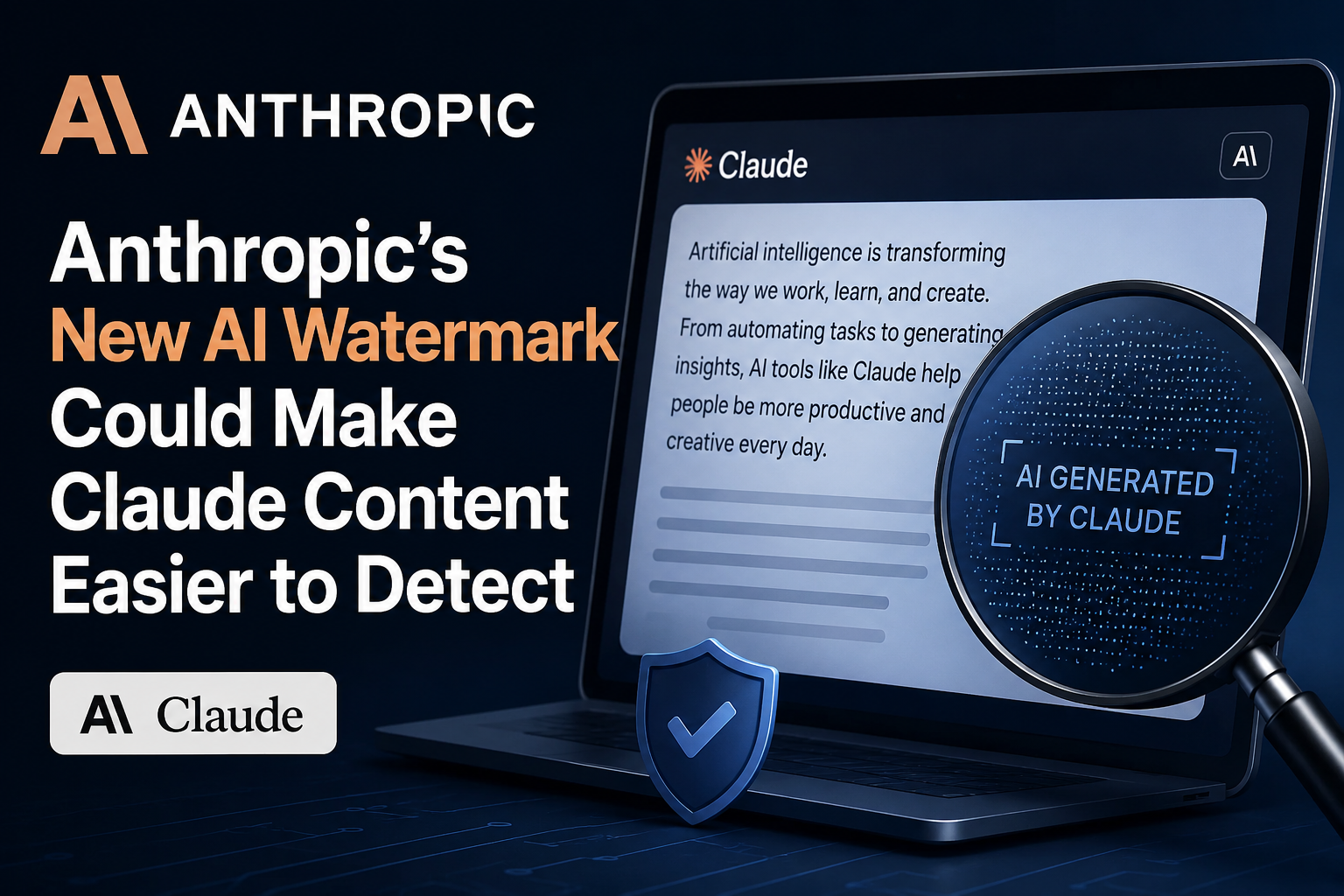
Anthropic has introduced a new way to mark content generated by its Claude AI models. The company is adding invisible, machine-readable watermarks to Claude-generated text, making it possible to identify content that was produced with Claude.
The move is attracting attention because AI-generated writing is becoming increasingly difficult to distinguish from human writing. Instead of relying only on traditional AI detectors that try to guess whether something was written by AI, watermarking creates a signal that can be checked later.
Anthropic’s move also comes as new transparency requirements under the European Union’s AI Act take effect.
What Is Anthropic’s New AI Watermark?
An AI watermark is a hidden signal added to content when it is generated.
Unlike a normal watermark on an image, you will not see Anthropic’s watermark while reading Claude’s response. The signal is designed to be machine-readable and can be checked using detection technology.
Anthropic’s system applies the marking at the model level. This means the watermark can be associated with content generated through Claude rather than being something that a user has to manually add after generating the content.
The important point is that this is not simply a hidden word or an invisible character that appears at the end of a response.
Instead, the watermark is incorporated into the generated text itself. Reports about the technology describe it as an imperceptible pattern within the text that can be identified by a machine.
Why Is Anthropic Adding Watermarks to Claude?
One major reason is AI transparency.
The European Union’s AI Act requires providers of generative AI systems to make AI-generated content identifiable in a machine-readable way. These transparency requirements became applicable in August 2026.
Anthropic is therefore moving toward a system that can help identify content generated by its AI models.
The company is not alone in exploring this technology. Google has already developed SynthID for identifying AI-generated content, while the wider AI industry is also working on content provenance and authentication systems.
This suggests that identifying where AI-generated content came from could become a normal part of using generative AI.
Could This Make Claude-Generated Text Easier to Detect?
Yes, but there is an important limitation.
The watermark can potentially help determine whether text was generated by a model that uses Anthropic’s watermarking system. It does not mean that every piece of AI-generated text on the internet can suddenly be detected.
For example, if someone writes an article completely themselves, there is no Claude watermark.
If someone generates an article using Claude and keeps the generated text largely intact, the watermark could provide a signal that the content came from Claude.
But if the text is heavily rewritten, transformed or passed through other systems, detecting the original watermark can become more difficult.
That means Anthropic’s technology should not be confused with a universal AI detector.
Does Copying and Pasting Remove the Watermark?
This is one of the most interesting parts of the story.
Because the watermark is designed around the generated text rather than being a simple file attachment or visible label, normal copying and pasting does not necessarily remove it.
That is different from traditional metadata-based identification.
However, the strength of any text watermark depends on how much of the original text remains unchanged. Research into AI text watermarking has shown that robustness, detectability and text quality are difficult to balance, especially when content is deliberately modified.
So it would be inaccurate to say that the watermark is impossible to remove.
What Happens If AI Rewrites the AI Text?
This is where things become more complicated.
Imagine someone asks Claude to write an article. They then take that article and ask another AI model to rewrite it completely.
The second version may contain much less of the original signal.
Similarly, substantial human editing could potentially weaken the watermark.
This is one reason experts generally view watermarking as a provenance or identification tool rather than a perfect AI detector.
The technology can provide evidence about the origin of content, but it cannot guarantee that every sentence can always be traced back to the original AI model.
What About AI-Generated Files?
The new system is not limited to plain text.
Reports say Anthropic is also using provenance information for generated files, including signed metadata based on the C2PA standard where supported. C2PA is an industry framework designed to provide information about the origin and history of digital content.
This could become particularly important as AI-generated images, documents and other digital files become common in workplaces.
A file could potentially carry information showing that it was created or modified using an AI system.
Why Are Some Claude Users Worried?
The technology has also created concerns among some Claude users.
Students and employees are particularly interested in the development because AI tools are now widely used for writing, research, coding and other professional tasks.
Some users worry that watermarking could make their use of Claude easier for schools or employers to identify. TechCrunch reported concerns from users who fear that the new system could expose AI use in academic or workplace settings.
However, identifying AI assistance does not automatically tell someone whether the use of AI was allowed or inappropriate.
For example, one company may encourage employees to use Claude for brainstorming, while another company may prohibit AI-generated content for certain tasks.
The watermark can potentially provide information about origin, but the rules around acceptable AI use are still determined by the organization.
AI Watermarking Is Becoming a Bigger Industry Trend
Anthropic’s announcement is part of a much bigger movement.
Google has developed SynthID, which can identify content generated by Google’s AI systems. Research and industry efforts are also exploring watermarking for text, images, audio and video.
Open standards such as C2PA are also being used to establish digital content provenance.
The goal is increasingly moving beyond simply asking:
“Was this made by AI?”
The industry is moving toward a more useful question:
“Where did this content come from, and can we verify its origin?”
That could become especially important as AI-generated content becomes harder for people to distinguish from human-created content.
Will Anthropic’s Watermark Stop AI-Generated Content From Spreading?
Probably not.
Watermarking does not prevent people from creating or sharing AI-generated content. It simply provides a way to identify or verify its origin.
It also does not prove that information in the content is true.
A watermarked article could contain accurate information, incorrect information or completely fabricated claims.
This is an important distinction because provenance and truth are two different things.
A watermark can potentially answer who or what generated something. It cannot automatically answer whether the information is correct.
What Does This Mean for the Future of AI Content?
Anthropic’s decision could be an important step toward a future where AI-generated content carries some form of digital identity.
Today, people often rely on AI detectors that estimate whether a piece of writing looks AI-generated. Those systems can be uncertain and can produce false positives.
Watermarking takes a different approach by placing a signal into content during generation.
If more AI companies adopt compatible systems, platforms could eventually have better tools for identifying AI-generated articles, images, videos and documents.
But the technology will need to become reliable enough to survive normal editing and content transformation without incorrectly identifying human-written material.
The Bottom Line
Anthropic’s new AI watermark could make Claude-generated content easier to identify, but it is not a magic AI detector.
The biggest change is that AI identification is moving toward content provenance rather than simply guessing whether something “sounds like AI.”
For Claude users, this means AI-generated text may become easier to associate with its source. For businesses, schools and online platforms, it could provide another tool for understanding where digital content came from.
At the same time, watermarking has limitations. Heavy editing, rewriting and transformation can make detection more difficult, and a watermark cannot determine whether the content itself is accurate or misleading.
Still, Anthropic’s move could mark the beginning of a much bigger shift in how AI-generated content is identified across the internet.
As AI becomes a normal part of writing and creating digital content, knowing where something came from may become just as important as knowing what it says.